Ella Adaïewsky, Les Chants de l'Église Grecque

Shota

Παλαιό Μέλος
Here is an article

Ella Adaïewsky, Les Chants de l'Église Grecque-Orientale, Rivista musicale italiana, VIII, pp. 43-74, 579-602, 1901.

It starts with some generalities on the Orthodox hymnography and then moves into musical analysis of various pieces. The author seems to have lived in Venice. The work is not particularly deep, but being one of the early Western studies on Byzantine music, it is of some interest.
 

Attachments

  • LesChants.pdf
    4.3 MB · Views: 138
  • LesChants_p1.pdf
    8.5 MB · Views: 108
Here is an article

Ella Adaïewsky, Les Chants de l'Église Grecque-Orientale, Rivista musicale italiana, VIII, pp. 43-74, 579-602, 1901.

It starts with some generalities on the Orthodox hymnography and then moves into musical analysis of various pieces. The author seems to have lived in Venice. The work is not particularly deep, but being one of the early Western studies on Byzantine music, it is of some interest.
Thanks, Shota!
The "Phos ilaron" on p. 73 must be the same as that given by Gaisser in the Canti Italogreci (i.e. Arberesh, "Arvanitika", of my compatriots:)!) . I think something of it has been translated and published in "Mousikos Logos" (from the Ionian Univ.) and I have seen it there as "Agioreitikon", exactly as the present author describes it.
So, we have a short traditional melody for this chant!
 
Last edited:
Thanks, Shota!
The "Phos ilaron" on p. 73 must be the same as that given by Gaisser in the Canti Italogreci (i.e. Arberesh, "Arvanitika", of my compatriots:)!) . I think something of it has been translated and published in "Mousikos Logos" (from the Ionian Univ.) and I have seen it there as "Agioreitikon", exactly as the present author describes it.
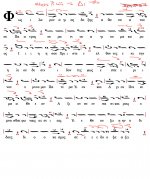
So, we have a short traditional melody for this chant!

Can someone chant this "Phos ilaron" on p. 73 or write it out in byzantine notation, for those of us who do not read western notation?

Merci!

. . .
 
Can someone chant this "Phos ilaron" on p. 73 or write it out in byzantine notation, for those of us who do not read western notation?

Merci!

Here it is! There is a problem with the transcription, concerning the tonality (the intervalls of the mode), which needs some discussion. I perform a kind of "reconstruction", based on the usual scale of echos deuteros.
PS Gaisser copies the melody from Adaïewsky's article, in order to make a comparison with its italo-grecian counterpart. The specific melody is presented by both writers as Athonitic.
 

Attachments

  • Φως ιλαρόν.mp3
    1.6 MB · Views: 114
Last edited:
Here it is! There is a problem with the transcription, concerning the tonality (the intervalls of the mode), which needs some discussion. I perform a kind of "reconstruction", based on the usual scale of echos deuteros.

Here is a transcription of the same into (Chrysanthine) Byzantine notation, also employing the usual martyriæ of Second Mode.
 

Attachments

  • Φως Ιλαρόν - Ada?ewsky.pdf
    29.8 KB · Views: 136
And for archiving purposes all above posts combined in a dual page musical PDF, containing the Athonaitic Phos hilaron in european notation from Adaïewsky's article (thanks Shota) along with Basil Crow's byzantine transcription and Eustathios Markri's interpretation.
  • In order to listen to it just press on the photo and permit execution from your pdf reading program
 

Attachments

  • Φως Ιλαρόν - Ada_ewsky E.Makris MP3.pdf
    1.5 MB · Views: 61
Last edited:
As a little additional remark, p. 70 of the article implies that the "Athonite" melodies of the article (and hence "Phos ilaron" too) have been transcribed from Bartholomaios Koutloumousianos' student.
 
Because there is often a need - especially in parishes - for Vespers to not last too long and because I think that "Fos ilaron" is a hymn and therefore it would be good - I think - to chant it instead of reading it, I propose this abbreviation. The duration of the chant is 50 to 60 seconds. So, it will be sung more often than read.
And because it ends in "βου", I consider it to be plagial second mode.

IMG_7895.jpeg
 
There's another topic in the Greek forum, where Eustathios Makris announces an article. I don't know whether it has appeared in print yet. Given biblical times in musicology publications, I won't be surprised if hasn't.

 
See here, towards the end of the article

A transcription into Byzantine Notation of the Paris Φῶς Ἱλαρόν presented at the end of the article.
 

Attachments

  • Φῶς Ἱλαρόν - χφ. Παρισίου.pdf
    138.8 KB · Views: 71
Back
Top